António Martins
I build ideas, systems, platforms and ventures designed to create positive impact beyond the present moment.
AI-Human Systems Architect, strategist and builder working at the intersection of artificial intelligence, organisational design and human potential.
I was never interested in what already existed.
From the beginning, my instinct was to look slightly ahead. Not to predict. To build.
In 1998, I co-founded one of Portugal's first internet service providers, not because I knew what the internet would become, but because I could see the shape of what was forming. That instinct has never changed. Neither has the method.
I am obsessed with systems. Not technology alone. Not people alone. Not strategy alone. The invisible architecture that connects them — and the structural failures that emerge when that architecture is absent or badly designed.
For twenty-five years, I have worked across contexts that most people keep separate: building companies, advising elite athletes, designing educational programmes, developing frameworks for organisations in transition, and creating technology for real-world problems.
The diversity is not accidental. Every domain has taught me the same thing from a different angle. When the system is well designed, performance emerges naturally. When it is not, no amount of talent, technology or effort compensates. None.
I refuse to separate technology from humanity. Not as a philosophical position. As a practical one. Every project where they were treated separately failed in the same way. The technology was adopted. The system did not change. The people adapted superficially. Three years later, nothing meaningful had evolved.
I founded Bitsapiens as a laboratory for the inverse of that failure. A place to build AI-native systems where human intelligence and artificial intelligence are not in tension. They are in composition.
Through Bitsapiens AI-Human Research, I lead an applied research programme investigating how human cognition changes when it operates alongside artificial intelligence, and what that change demands from individuals, organisations and institutional design. The programme draws on cognitive science, organisational behaviour, computational linguistics and strategic design.
What drives me is not the present state of things. It is the distance between what exists and what is possible.
But that distance is not abstract to me. It is where purpose begins.
The work I do now is the most consequential expression of that obsession: using writing, research, systems, ventures and relationships to create positive impact beyond the present moment.
Not because AI is the most important technology of our time. But because the question of how humans and intelligent systems evolve together is one of the defining design challenges of this century. And it is, at its core, a human question.
I have always lived in the future. But the work is not to escape the present. The work is to build enough of the future now that others can begin to move towards it.
I am passionate about the future and about the world I will never live to see.
My purpose is to create positive impact in the world.
Through my writing, my content, the businesses I found or invest in, and the relationships I cultivate, I seek to create value that continues to expand beyond myself.
When I write, I want words to provoke movement, reflection and action.
When I create or invest in companies, I want those structures to improve the lives of those who take part in them, work in them, buy from them, learn from them or grow through them.
When I relate to other people, I start from the conviction that everyone has potential. I want to elevate, challenge and help unlock that potential, while also learning from everyone and receiving new perspectives on the world.
The way I express this purpose evolves every day. But the essence remains the same: to transform ideas, relationships and businesses into real value, with positive impact beyond the present moment.
See patterns
I connect ideas, disciplines and contexts that most people keep separate. Technology, business, sport, education, human behaviour and strategy have all taught me the same lesson: the visible problem is rarely the real problem.
Impact begins when hidden patterns become visible.
Build systems
I do not believe in ideas that remain abstract. I build companies, platforms, frameworks and operating systems because construction is how vision becomes real.
Impact becomes possible when intention is turned into structure.
Unlock potential
I believe every person carries potential. The role of good systems, good leadership and good relationships is not to control people, but to create the conditions for that potential to emerge.
Impact lasts when people, not just processes, evolve.
Create platforms
Some ideas only become valuable when they become platforms.
I build and invest in systems where people, technology, communities, data, rights, assets or capital can interact repeatedly and create value over time.
Impact compounds when value is not created once, but designed to repeat.
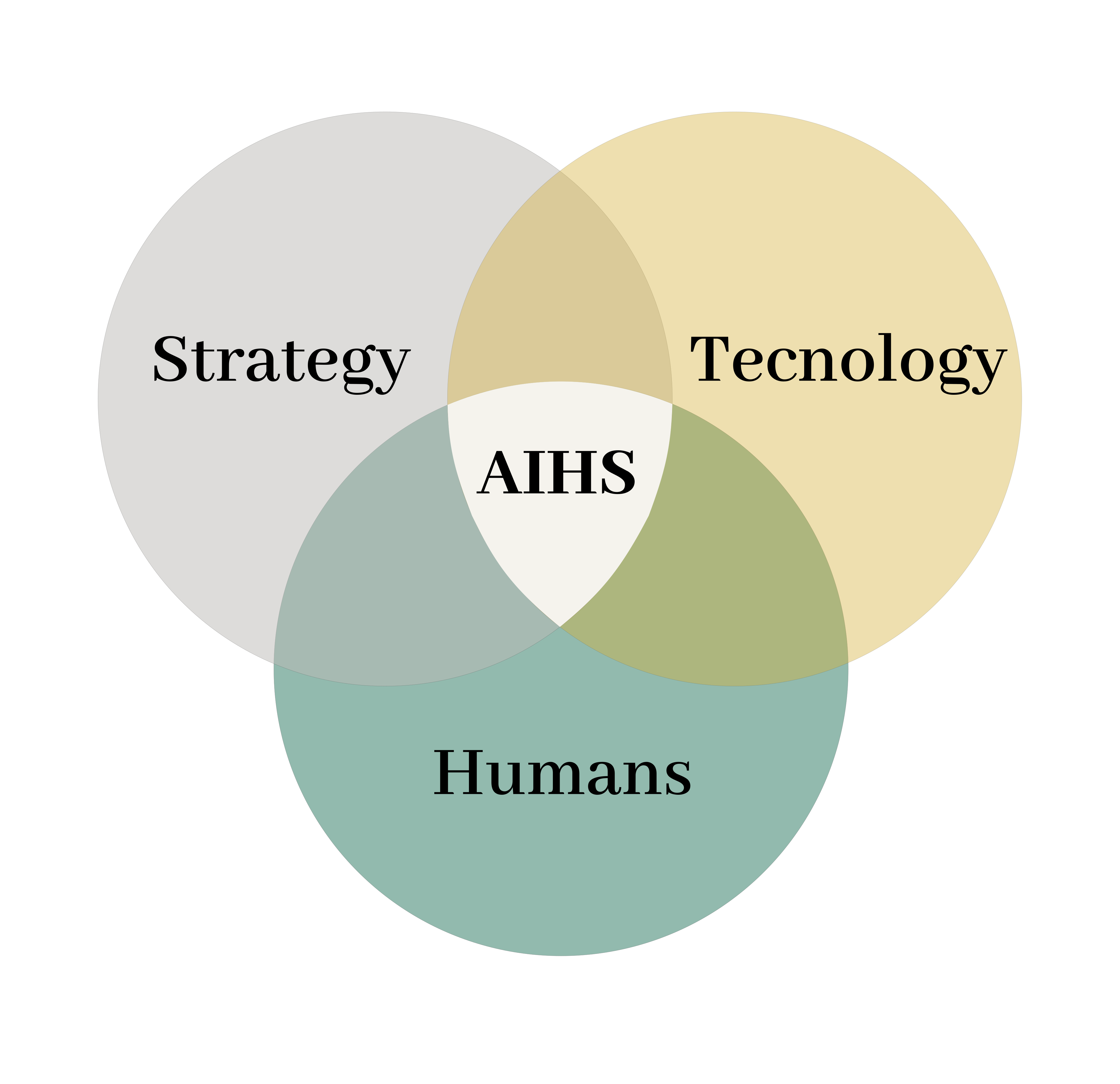
Strategy, technology and humans. Designed as one system.
From these three fields, and through this way of working, emerged AI-Human Systems — the accumulated pattern of what I have seen work, and what I have seen fail, across twenty-five years of building at the intersection of strategy, technology and human performance.
AI-Human Systems is not about adopting artificial intelligence faster. It is about redesigning the way people, processes, decisions and intelligent systems operate together.
The next decade will not belong to organisations that merely use AI as another tool. It will belong to those that redesign their systems around a new relationship between human intelligence and machine intelligence.
AI-Human Systems is the core of this work, but its application is broader than AI transformation alone. It informs how I think about ventures, platforms, sports ecosystems, music rights, education, leadership and institutional change.
Strategy
Twenty-five years building and scaling businesses taught me that strategy is not about plans. It is about architecture — the invisible structures that determine whether an organisation thrives, adapts or fractures under transformation.
Technology
I have designed digital products, platforms and infrastructure across different sectors and markets since 1998. Technology changes what is possible. But the right architecture of technology changes how people think, decide and operate — and that changes everything.
Humans
The deepest insight from two decades working with founders, leaders, teams and elite performers is that performance is never about talent alone. It is about cognitive systems — how people think, decide, collaborate and adapt under pressure. That insight shaped everything that followed.
Living in the future. Building in the present.
Living in the future
This is the intellectual and creative layer of my work.
It is where I explore what is emerging, what is changing and what the world may require next. Through writing, research and reflection, I try to make sense of the future before it becomes obvious.
Not to escape the present. To give it direction.
Build in the present
This is the practical layer of my work through Bitsapiens.
It is where ideas are turned into systems, ventures, platforms, frameworks and operating models. The future only becomes meaningful when it is translated into decisions, products, teams, workflows and institutions that can exist now.
The work is not to predict the future.
The work is to build enough of it in the present that others can begin to move towards it.
For me, systems are not only technological. They can be organisational, human, cultural, commercial or experiential.
A sports ecosystem, a music rights platform, an AI-native company, an educational programme or a venture studio may appear to belong to different worlds.
They do not.
They are all expressions of the same work: designing the architecture that allows potential to become value.
Bitsapiens
AI-native venture studio · Founder & CEO
Bitsapiens is where my future-facing thinking becomes practical construction.
It is an AI-native venture studio built on a single premise: the organisations and builders that understand the real relationship between AI and human systems will define the next decade.
We do not just advise on AI adoption. We design the cognitive and operational architecture that makes transformation real, measurable and difficult to reverse.
Core areas:
- — AI-Human Systems advisory
- — Venture building and co-founding
- — Research and frameworks
- — Education and community
Portfolio & advisory positions
Investor · Advisor · Builder
Prisma Music
Music rights and royalties company. Prisma Music helps artists, composers and rights holders centralise, understand and optimise their music royalties.
For me, Prisma Music represents the application of systems thinking to the creator economy: transforming fragmented rights, opaque data and scattered income streams into clearer infrastructure for long-term creator value.
SportsNext
Active · Founder / Strategic Advisor
Strategic advisory platform for sports, entertainment, technology and experiential ecosystems. SportsNext helps organisations transform venues, communities, events, creators, partners and digital platforms into connected ecosystems of engagement and long-term value.
Arena X
Concept / Venture creation model
AI challenge and venture creation platform designed to transform real organisational problems into pilots, products and potential startups.
Dax Ledger
Crypto compliance and digital asset infrastructure.
Serendipity Capital
Strategic investment in AI, deep tech and future-facing ventures.
I also co-founded AI Around The World — a global community connecting AI practitioners, researchers, and founders across borders.
Working Principles
Positive impact over noise
I build, write and invest in things that can create value beyond the moment in which they are made.
Systems over tools
Tools are commodities. Systems are competitive advantages. I do not recommend tools. I design the systems that make them valuable.
Clarity over complexity
Complexity is the enemy of execution. Every framework I build starts with making the invisible visible.
Potential over labels
I believe every person carries potential. Good systems do not replace people. They help unlock what people are capable of becoming.
Execution over theory
Ideas only matter when they survive contact with reality. I build things that work with real people, real teams and real constraints.