AI-Human Systems
Strategy. Technology. Humans. Aligned as one system.
AI-Human Systems is a research framework and design discipline focused on a single question: how do organisations redesign themselves — not just their tools — to function in the age of artificial intelligence?
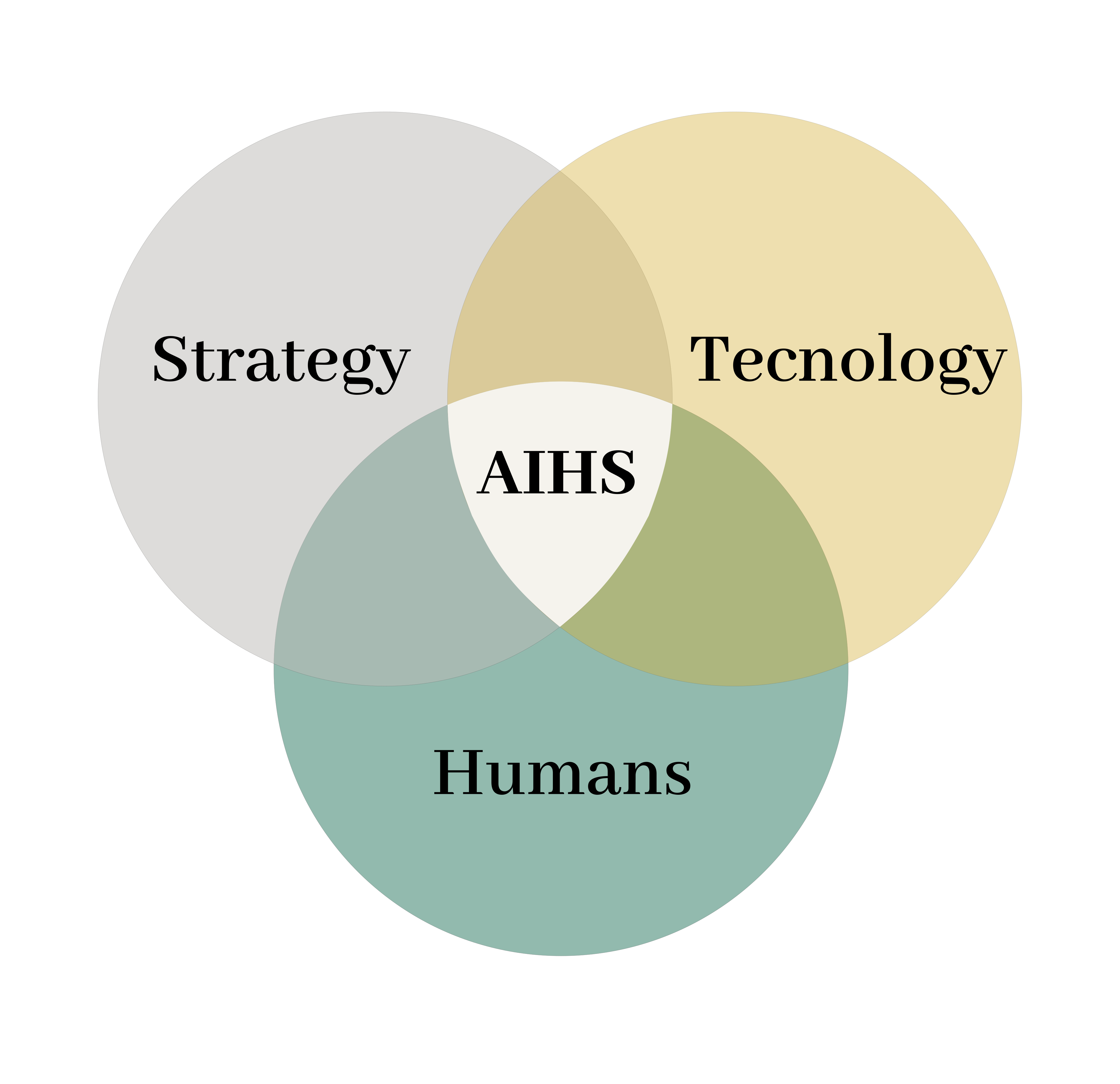
A research framework at the intersection of three fields.
AI-Human Systems is a research framework and design discipline focused on a single question: how do organisations redesign themselves — not just their tools — to function in the age of artificial intelligence?
It sits at the intersection of three fields: strategy — the architecture of how organisations make decisions and deploy resources; technology — the systems and tools that amplify or constrain human performance; and humans — the cognitive and behavioural layer that ultimately determines whether anything works.
None of these three fields alone is sufficient. Together, they form the system that determines whether an organisation thrives or fractures under transformation.
This is not a methodology. It is a doctrine — a way of seeing that reorganises everything else.
The AI revolution
is cognitive,
not technological.
The organisations that will win this decade are not the ones that adopt the most tools. They are the ones that redesign — intentionally — how technology, people, and business function as a single system.
The question is not “which AI tool should we use?” The question is: how does this organisation think? How does it decide? How does it learn? Only then do you choose the technology. Only then do you train the team.
Each pillar alone is faith.
All three pillars must be worked on simultaneously.
Not sequentially. Not selectively.
AI-Human Systems
Research how organisations evolve across five interconnected domains.
- BusinessSystems
How organisations create value and redesign their architecture for the AI era. AI-native models, new business structures and organisational redesign.
- TechnologySystems
The AI infrastructure, data architectures and automation systems that enable organisations to operate as intelligent, adaptive entities.
- HumanSystems
How individuals and teams operate inside complex technological environments. Behaviour, incentives and organisational culture in the AI era.
- CognitiveSystems
How artificial intelligence augments human thinking, learning and knowledge creation. Hybrid cognition, AI-assisted research and epistemic design.
- DecisionSystems
How decisions are made when intelligence is distributed between humans and machines. Governance, collective intelligence and decision architecture.
The frameworks and programmes that emerge from AI-Human Systems investigation.
Research without application stays in the drawer. Each domain of AI-Human Systems investigation produces frameworks, methodologies and programmes designed to be used — in organisations, in education, in leadership. These are the outputs.
Frameworks
PROBLEM[Framework]
A structured approach to innovation based on real problems, not ideas. The antidote to solutions looking for a problem.
AIceberg[Framework]
Cognitive SystemsDecision Systems
Transforms scattered data into decision-ready intelligence for leadership teams. Most organisations already have the information they need — it is buried beneath the surface.
UNLOCK.AI[Framework]
Cognitive SystemsHuman Systems
A framework for mapping human potential in the AI era — identifying what makes each person irreplaceable, and how AI amplifies rather than replaces it.
Prompt Design Thinking[Framework]
Technology SystemsCognitive Systems
A discipline for designing human-AI interaction with intention — treating prompting as cognitive architecture, not a technical trick.
Context Design Thinking[Framework]
Technology SystemsCognitive Systems
A discipline for managing context in AI interactions systematically. The core insight: information position determines model performance.
Agents Design Thinking[Framework]
A methodology for designing AI systems and interactions with a human-centred approach — applying design thinking to the architecture of AI-augmented organisations.
Programmes
AI-Human Thinking[Programme]
The programme built on the AI-Human Thinking framework.
The cognitive capacities for the hybrid era.
AI-Human Leadership[Programme]
Built on the AI-Human Leadership framework.
Decision-making and governance in AI-augmented organisations.
AI-Human Performance[Programme]
Behavioural performance drawing from elite sport methodology.
These are not the only outputs. They are the ones currently active.
This is the foundation of AI-Human Systems.
This is not a methodology. It is a doctrine — a way of seeing that reorganizes everything else.
The question is not “which AI tool should we use?”
The real questions are: how does this organization think? How does it decide? How does it learn?
Only then do you choose the technology. Only then do you train the team. Only then do you redesign the processes.
Because the order matters. It always has.
The organizations that will win this decade are not the ones that adopt the most tools. They are the ones that redesign — intentionally — how technology, people, and business function as a single system.
I've seen this happen. And I've seen what happens when it doesn't.
The performance gap is decisive. And it compounds over time.
This research exists to map that difference — to name the patterns, and to give language to what most organizations sense but cannot yet articulate.
Architecture beats heroism.
Systems beat willpower.
Design beats improvisation.
AI-Human Systems is a research framework. It becomes practice through consulting, education, and advisory work with organisations, institutions, and founders.
See how we work togetherIf you're building this capability — or realising that your problem is more structural than it appeared — it's worth a conversation.
Start a Conversation